


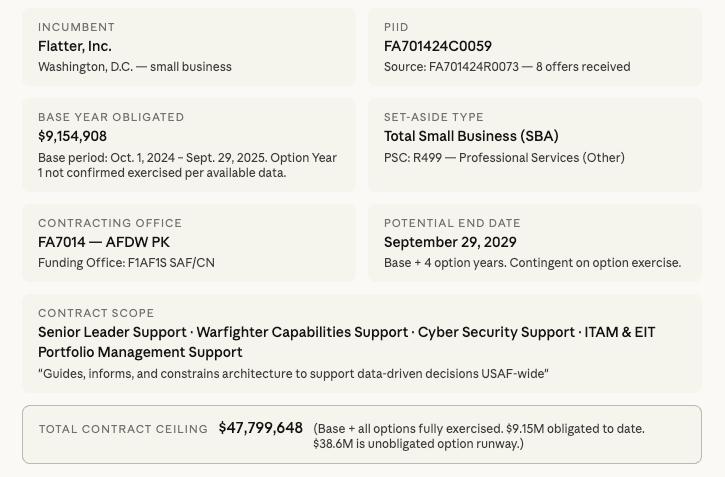
The government coded FA701424C0059 as R499 — Professional Services, Other. That single field tells you more about this contract's ceiling than its dollar value does. The contract description — "GUIDE, INFORM, AND CONSTRAIN ARCHITECTURE" — is advisory language. It describes a trusted advisor delivering architecture governance to senior leaders. The PSC code confirms it: R499, Support — Professional Services (Other). The government did not code this as an IT services contract. They coded it as professional advisory support.
The FY2026 AF RDT&E J-Books are now spending money at a different velocity and for a different mission. The USAF is not buying more advisory capacity. It is buying cloud infrastructure, AI/ML-integrated ISR pipelines, decentralized tactical-edge data retention, and a cyber engineering benchtop. Flatter's contract scope was architected for yesterday's buying signal. The budget shifted underneath it.
The Asset:
The Future Budget Reality
Six PE lines are moving. All figures and program narratives are drawn from the FY2026 AF RDT&E Budget Justification (J-Book). Where specific operational details extend beyond public J-Book language, they are marked accordingly.
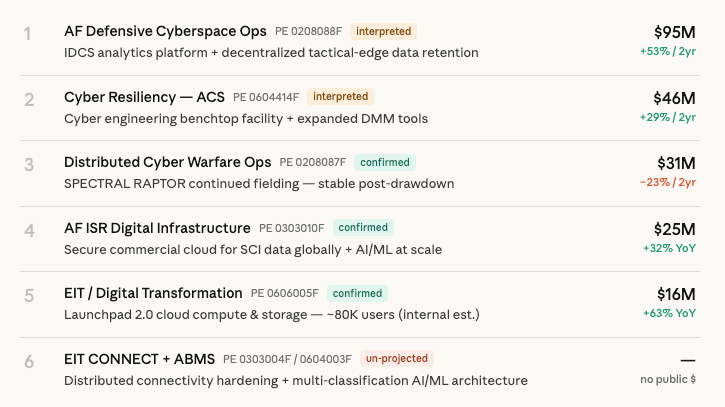
Source: FY2026 Air Force RDT&E Budget Justification (J-Book). Budget figures represent presidential budget request; enacted amounts may differ. Items marked "interpreted from program goals" extend beyond verbatim J-Book language based on analyst interpretation of program narrative.
The Structural Hack (The Disconnect)
Flatter's contract is built on the verb "GUIDE." Their four service categories — Senior Leader Support, Warfighter Capabilities Support, Cyber Security Support, ITAM and EIT Portfolio Management Support — are advisory governance functions. They brief flag officers. They produce architecture governance documents. They constrain decisions. The government confirmed this characterization when they coded the contract PSC R499: Support — Professional Services (Other). Not 541512. Not D302. Professional advisory support.
The FY2026 budget is buying three things this contract cannot deliver. First: production-scale cloud infrastructure. Cloud compute and storage at scale is a DevSecOps engineering problem, not an advisory one. Second: an IDCS analytics platform with decentralized data retention at the tactical edge. That requires data engineering depth and sustained access to classified operating environments that advisory shops rarely maintain. Third: a physical cyber engineering benchtop under PE 0604414F. That is hardware in a lab. It has nothing to do with architecture governance documents.
Flatter has a longstanding relationship with SAF/CN — demonstrated through the FA701424C0059 award and prior work under FA7014. Their contract history across Air Force leadership programs shows institutional trust. That trust does not transfer to cloud engineering delivery at production scale. The government's options are limited: expand Flatter's contract scope into domains where they have no documented delivery record, or buy the execution work through separate adjacent procurements where Flatter has no incumbent position. That seam is your entry point.
The PSC angle your competitors missed: R499 (Professional Services — Other) is the government's own classification that this work is advisory, not technical IT services. In any future recompete where the requirement shifts toward cloud engineering or cyber execution, the contracting office will almost certainly recode the PWS under a technical NAICS (541512 or 541519) and a D-series PSC — effectively opening a structurally different competition where Flatter's past performance as an R499 advisory shop carries less direct weight.
The Playbook: How to Intercept the Recompete
Competitive Intelligence
Solicitation FA701424R0073 (the two-step negotiated competition that awarded this contract) received 8 offers. Seven small businesses competed and lost. The market already sees this contract. Those seven firms are positioned, aware, and almost certainly building toward option-period influence or adjacent entry right now. Your urgency window is not theoretical.
Do not wait for the 2029 recompete. The option exercise decision on Option Year 1 is imminent — or has already passed. The next meaningful capture window is now, in the adjacent PE-funded procurements. PE 0303010F (AF ISR SCI cloud, +32% YoY) and PE 0208088F (IDCS platform, $95M in FY26) are the most likely sources of standalone solicitations. No public pre-solicitation has appeared on SAM.gov as of this writing — that is a signal to move before the crowd identifies the vehicle type.
Build your team around the technical gap Flatter cannot cover. You need a cloud infrastructure firm with active FedRAMP High authorization and demonstrated DoD IL5/IL6 delivery experience as your technical anchor. RAFT LLC (FA865021C9320 — $7,474,216 for the Enterprise Data Architecture Minimum Viable Product) is proof the government buys this work from purpose-built engineering firms under the same ABMS program umbrella. Identify firms with comparable delivery records inside SAF/CN's ecosystem.
The set-aside is Total Small Business. No ANC or 8(a) protection. This is an open small-business competition. If your revenue is approaching SBA size thresholds for NAICS 541512 or 541519, this is the decision point on Joint Venture structure — not post-award. A properly structured JV with a technically differentiated partner locks in your small-business eligibility while expanding your delivery capacity on day one.
The Launchpad 2.0 cloud angle. The EIT/DTO PE is buying cloud compute and storage at scale. Frame your capability around proven integration with existing USAF cloud environments — AFNET, Unified Platform, JADC2 adjacent infrastructure. Do not describe your stack as proprietary. Frame it as open-architecture deployment, specialized DevSecOps tuning for DoD environments, and repeatable IL5/IL6 cloud migration pipelines. This is your proof-of-concept wedge into FA7014 before the advisory recompete surfaces.
The IDCS and tactical edge angle. PE 0208088F's mandate for decentralized data retention at the tactical edge is a specific engineering requirement. Identify firms with demonstrated zero-trust architecture implementations at the edge — specifically those with exposure to Unified Platform, DCO ecosystem contracts, or SPECTRAL RAPTOR-adjacent programs. Bring that capability in as a named subcontractor with an explicit clearance pedigree. Do not lead with it on a cover page without the cleared personnel to back it up.
The PSC recode is your longest play. When this recompete eventually structures as an engineering and execution requirement — not an advisory one — watch for a NAICS and PSC shift. A D302 or D307 PSC on a recompete solicitation is the government telling you the scope has fundamentally changed. That is where a cloud-execution prime with Air Force cleared delivery history displaces an advisory incumbent regardless of relationship depth.
FA7014 is not a cold-call contracting office. SAF/CN moves fast and knows its primes. An industry day response, a white paper on cloud architecture governance and execution integration, or a Mentor-Protégé agreement with a firm that already holds FA7014 task orders will do more in the next six months than any unsolicited capability statement.
The Bottom Line: Eight firms bid this contract. Seven lost. The one that won advises. The budget needs builders.
If you want me to map out your specific 24-month pipeline and build the agency shaping strategy for your NAICS code, I do a one-time, $7,500 Capture Architecture Sprint.
Reply "Architecture" to this email if you want to look at the framework.
Happy hunting,
Micah Dickson
Managing Director, TallyPoint Advisors Fractional CGO