


Part one of The Future of GovCon
The big picture: The federal government must confront more and increasing threats, old and failing infrastructure, fragile supply chains, and out of date technology while debt costs consume more of its budget.
Why it matters: Washington will keep spending, but the money will become harder to win and more closely tied to urgency, building domestic capacity, and real measurable results.
My view: The procurement system was built for a world where we had more time. Slow buying is becoming a real risk.
The bottom line: GovCon firms that help the government move faster without creating more risk will pull ahead. Business as usual is not coming back.
The federal government has less room to move at the exact moment it needs to move faster.
Debt service is consuming more of the budget. Physical and digital infrastructure need major work. The United States has rediscovered that it cannot make enough of some things it would need in a crisis. With that much pressure, the system will not operate under business-as-usual.
That pressure will shape what the government funds, what it cuts, how it buys, and which contractors it trusts to move quickly without creating another problem.
This is the starting point for how I see the future of government contracting.
Why I read the market this way
I did not grow up in government contracting. I did not spend time in the military or graduate from a feeder school into government. I started in corporate finance in the banking sector.
I was attracted to finance because it gave me a way to professionalize my natural interest in geopolitics, economics, and history. Finance is about incentives, and you learn a lot about incentives by studying people and history. Someone I worked with introduced me to government contracting, and I found it fascinating. It brought together the subjects I cared about and gave me a direct view into how public decisions become business decisions.
That varied background is why my perspective is a little different. I use trends, historical analysis, and big themes to make sense of the market. The big theme I see now is that the world is changing faster than the United States government is built to respond.
The country has faced pressure before. What makes this period different is the number of problems arriving at the same time and the shrinking room available to deal with them.
The budget has become a strategic constraint
In fiscal year 2025, net interest spending exceeded federal spending on national defense.[1]
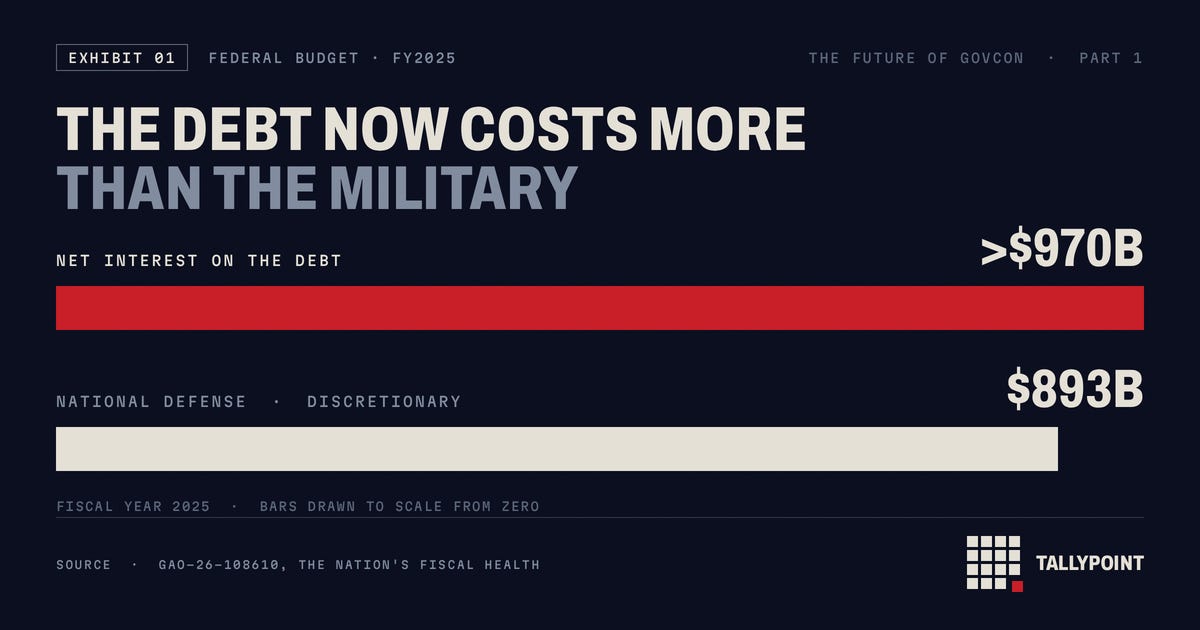
The most militarily capable country in history now spends more servicing its debt than it spends on national defense. Rome did not fall for one reason, and I am not going to pretend the United States is Rome with Wi-Fi. But history is clear about one thing: great powers become brittle when the cost of maintaining the system begins to crowd out the basic work of defending and renewing it.
The debt, annual deficits, and federal spending are debated constantly. I am not saying anything revolutionary by pointing to them. What is different now is that the outside world requires serious decisions at the same time our financial runway is narrowing. GAO projects publicly held debt will reach 123% of GDP by 2036 under current policy. It also warns that rising debt can reduce the government’s ability to respond to war, natural disaster, or financial crisis.[1]
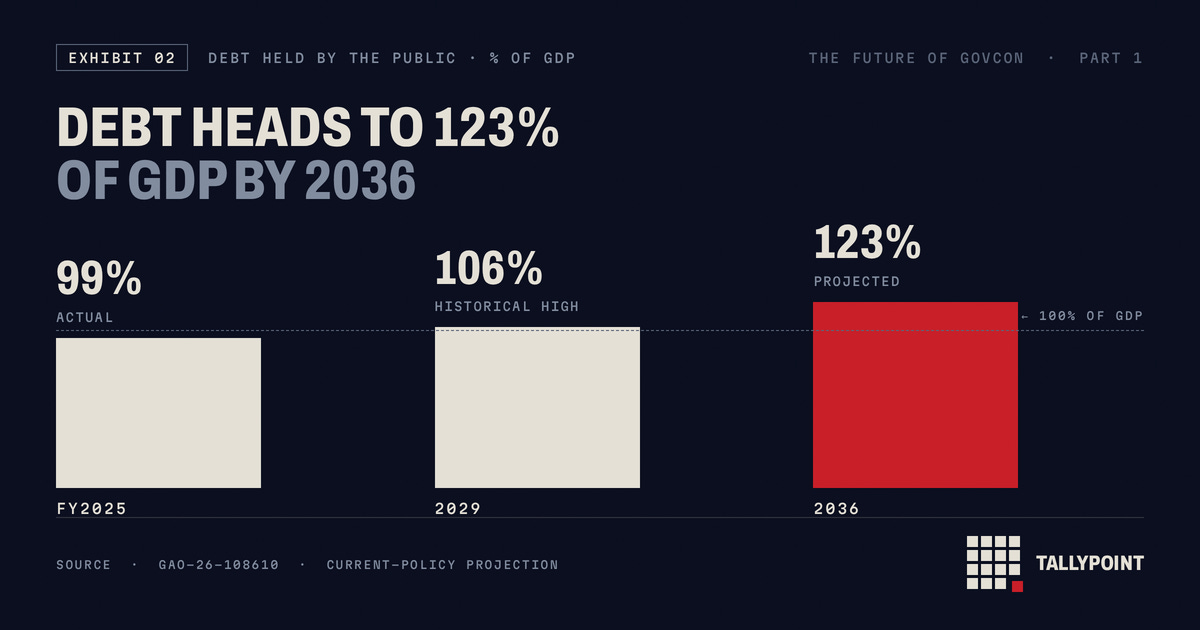
That is the part of the debt debate GovCon leaders should watch.
The federal government is not going to stop spending. It cannot. Its missions are too large, and many of the threats are real. But the money will become more contested. Programs will have to prove urgency. Leaders will search for visible savings. Work that once survived through institutional momentum will face harder questions.
Fiscal pressure will not make the federal market smaller in a clean or predictable way. It will make the market harsher.
Money will still move, but it will move toward the problems political leaders believe they cannot postpone.
The repair bill is already here
And the repair list is already long.
The Federal Highway Administration counted 41,685 bridges in poor condition in 2025.[2] The Department of Energy says the electric grid is aging and being pushed to do more than it was designed to do.[3]
The same problem exists inside the government.
The same problem exists inside the government. GAO reviewed 69 federal legacy IT systems and identified 11 that most needed modernization. Some were between 50 and 60 years old. Eight used outdated programming languages, four had unsupported hardware or software, and seven had known cyber vulnerabilities.[4]
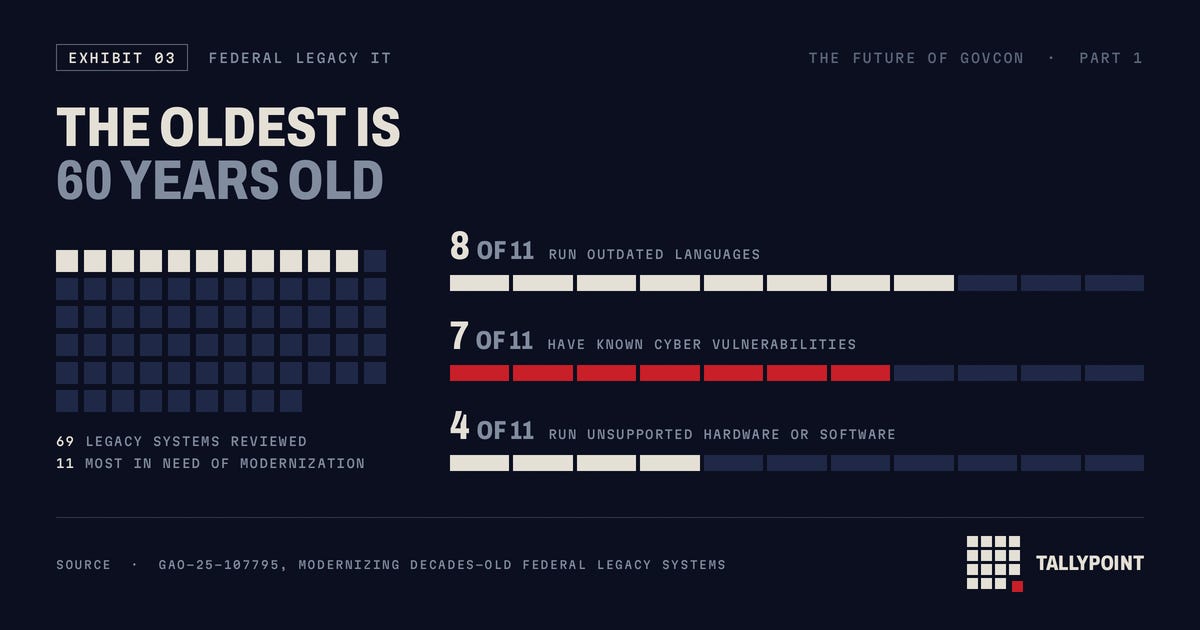
This is the bill from decades of delay. Washington has to maintain yesterday’s systems, operate today’s government, and prepare for tomorrow’s threats with the same dollar. Every year spent working on old infrastructure is a year in which money and talent are not building the future.
This is what decades of delay look like. Washington has to maintain yesterday’s systems, operate today’s government, and prepare for tomorrow’s threats with the same dollar.
That is not a clean austerity story where everything simply gets cut. The government cannot stop spending on defense, disaster response, health, benefits, cyber, or basic operations. It will keep spending. But the money will become more contested, and leaders will become less patient with work that cannot explain why it matters now.
COVID exposed what the country could no longer make
COVID showed us how vulnerable we were.
We learned how little we manufacture domestically and how much of the economy depends on supply chains we do not control. The United States struggled to secure enough masks, gloves, testing supplies, and other medical equipment. GAO found that the pandemic exposed weaknesses in the medical supply chain and renewed concern about reliance on foreign manufacturing for many drugs.[5]
Then came the obvious question: What else do we not make that we would need in a crisis?
Once you ask it, the list gets uncomfortable. Munitions. Batteries. Microelectronics. Shipbuilding. Grid equipment. Communications hardware. The components buried inside larger military and civilian systems.
This is why the industrial base is suddenly everywhere in Washington. It is a fancy term for something simple: the companies, workers, factories, materials, and equipment needed to make the things the country depends on.
And time matters. A factory does not appear because the government suddenly needs one. Skilled workers do not appear. Supply chains do not rebuild themselves. Production capacity has to exist before the emergency begins.
The Threats are Real and Growing by the Day
The world is changing as the global order continues to change from a singular to a multi-polar world. The probability of the next emergency is increasing.
The emergency does not have to be a war. The 2026 Annual Threat Assessment describes risks from major powers, cyber actors, terrorism, transnational crime, weapons proliferation, and new technology.[6] Natural disasters and another pandemic remain part of the picture. The government has to prepare for several kinds of crisis at once, even though most of them may never happen.
That is expensive. It is also unavoidable.
The 2026 National Defense Strategy makes rebuilding the defense industrial base one of its main lines of effort.[7] DoD’s first National Defense Industrial Strategy also calls for stronger supply chains, more production capacity, and a broader supplier base.[8]
Administrations will come and go. This focus will not.
I expect more programs, financing tools, and rule changes that favor companies able to manufacture in the United States or reduce dependence on exposed supply chains. But putting a flag on a capability statement will not be enough. The government will want to know whether a company can actually produce, meet the standard, and keep producing when the system is under stress.
The buying system was built for a calmer world
All of this pressure eventually reaches an acquisition team.
And that team is often overloaded.
GAO interviewed 55 acquisition personnel across four DHS components. Forty-one named heavy workload as their largest challenge. DHS components reported acquisition hiring times ranging from three to eighteen months.[9]
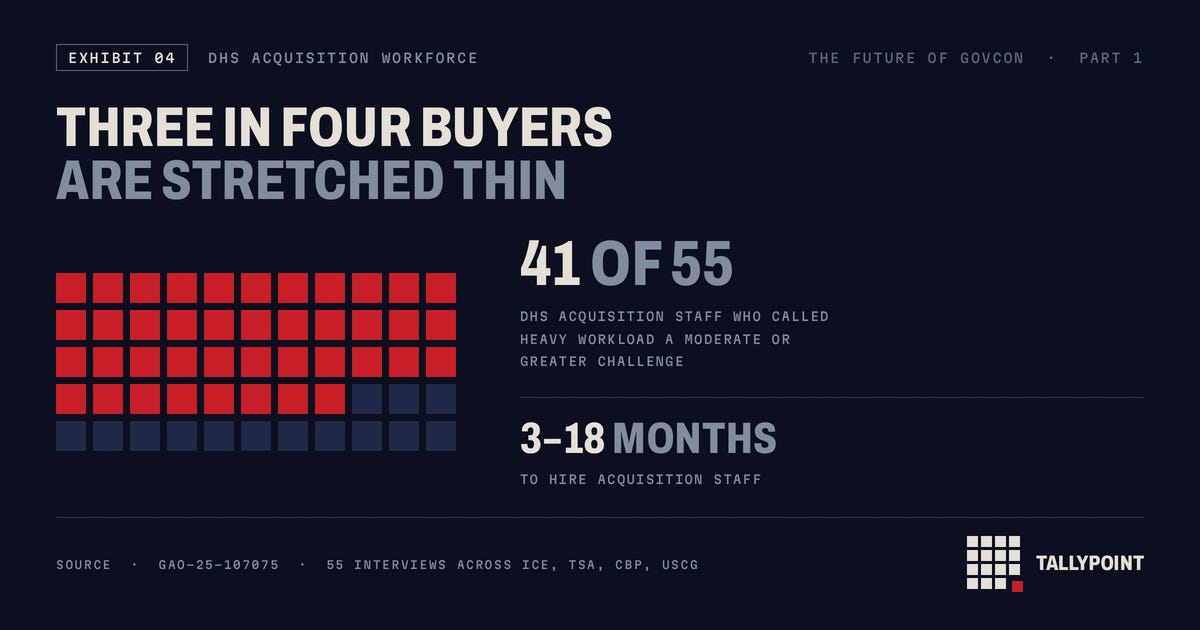
Stressed teams fall back on what they know. They use familiar vehicles, existing vendors, conservative evaluation methods, and acquisition plans that reduce administrative work. Think hitting the easy button under stress.
That behavior makes complete sense. A contracting officer who is carrying too much work does not have unlimited time to pioneer a new path for every promising company.
This is where many contractors misunderstand the buyer.
They explain why the government should want the solution. They do not explain how the government can buy it, measure it, secure it, transition to it, and defend the decision if something goes wrong.
In the next market, reducing the government’s buying burden will become part of the value proposition.
A useful market-research response may matter more than another page of corporate history. A clear performance measure can lower the risk of trying a new vendor. A workable buying path can turn program interest into a contract. A credible transition plan can make change possible inside an office that cannot tolerate disruption.
Procurement cannot remain dominated by process for its own sake. But contractors should not wait for Washington to repair the system before changing how they compete.
The firms that make a good decision easier to reach and easier to defend will have an advantage.
Pressure will reorder the market
The federal government is not running out of work that needs to be done. It is running out of room.
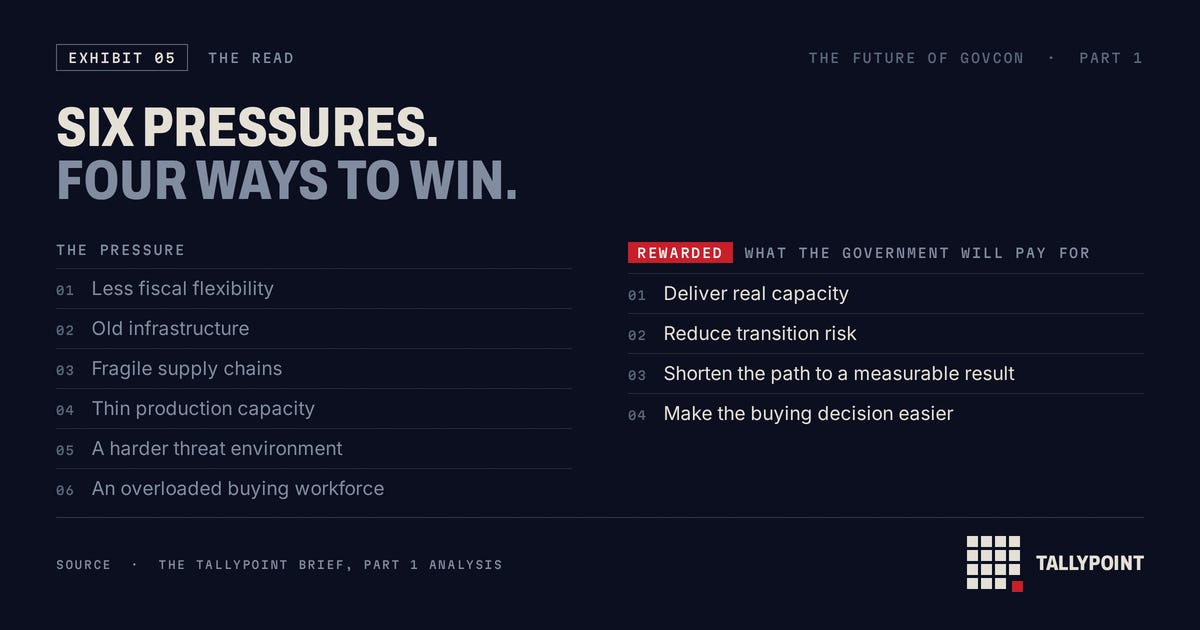
It has less fiscal flexibility, old infrastructure, fragile supply chains, thin production capacity, a difficult threat environment, and a buying workforce asked to carry all of it.
That combination will not produce one clean reform or one new acquisition model. Nothing in Washington is that easy.
Some offices will move faster. Others will become more cautious. Some programs will gain political urgency and money. Others will spend years fighting to survive. Some contractors will benefit from their incumbency. Others will discover that the customer is willing to break an old buying habit when the pressure becomes high enough.
The direction is still clear.
The government will reward firms that help it act under pressure. That means delivering real capacity, reducing transition risk, shortening the path to a measurable result, and making the buying decision easier.
The old market was built around the assumption that time was available.
The next one will be built around what happens when it is not.
Sources
[1] https://www.gao.gov/americas-fiscal-future — GAO: America’s Fiscal Future
[2] https://www.fhwa.dot.gov/bridge/nbi/no10/condition25.cfm — FHWA: Bridge Condition by Highway System, 2025
[3] https://www.energy.gov/oe/grid-modernization-and-smart-grid — Department of Energy: Grid Modernization and the Smart Grid
[4] https://www.gao.gov/products/gao-25-107795 — GAO: Modernizing Decades-Old Federal Legacy Systems
[5] https://www.gao.gov/products/gao-21-265 — GAO: COVID-19 Medical Supply Chain Findings
[6] https://archive.dni.gov/files/ODNI/documents/assessments/ATA-2026-Unclassified-Report.pdf — 2026 Annual Threat Assessment of the U.S. Intelligence Community
[7] https://media.defense.gov/2026/Jan/23/2003864773/-1/-1/0/2026-national-defense-strategy.pdf — 2026 National Defense Strategy
[8] https://www.defense.gov/News/News-Stories/Article/Article/3644527/dod-releases-first-defense-industrial-strategy — DoD Releases First National Defense Industrial Strategy
[9] https://files.gao.gov/reports/GAO-25-107075/index.html — GAO: DHS Acquisition Workforce Challenges