


Part two of The Future of GovCon
The big picture: The successful GovCon firm of the future will be ruthlessly focused on solving a specific problem for a set of federal customers. They will build a firm that will be focused on providing their solution in a repeatable way that customers can easily acquire.
What’s changing: Venture capital, upstream influence, consolidated contract vehicles, AI, and new pricing models are changing the competition before the RFP appears.
The new model: Stronger firms will organize around four connected systems: mission, access, proof, and economics.
The bottom line: A pipeline is not just a list of opportunities. It is a set of investments in the company leadership is choosing to build.
The next generation of GovCon firms will still sell labor. They will still need vehicles, relationships, past performance, clearances, and clean compliance.
But labor categories will not be enough to define the business.
The firms that win will focus on a real and long-term mission problem. They will build a repeatable way to solve it, shape a path the government can use to buy it, and turn delivery into past performance they can use again.
They will look less like collections of random contracts and more like mission companies run with product discipline, service-company accountability, and investor-grade financial control.
That transition will be harder than adopting AI.
The old model can grow revenue and weaken the company
The familiar GovCon growth model looks like this:
Win access to any contract that is “like” what we can do. Staff the contract. Perform well. Add more contracts kinda like the prior contract. Grow headcount.
There is nothing inherently wrong with that sequence. A good services company can create real value and good careers.
The trouble starts when that approach becomes the strategy.
Contract count alone becomes the KPI. Headcount becomes the only strategy. Vehicle logos just to say you have them, becomes the goal. The pipeline gets bloated because removing an opportunity feels like giving up growth.
Then leadership looks up after the fifth fire drill of the week and finds a company held together by a few contracts with almost nothing in common, a few customer relationships that are reliant on a few key government people, and program knowledge that lives in the heads of a few on-staff people.
Revenue may be growing while the business becomes harder to manage and margins shrink.
I learned the financial side of this problem before I learned the capture theory behind it. Winning work takes cash, management attention, delivery capacity, and time. A company can outrun all four.
That is why I do not view a pipeline as a list of possible awards. I view it as a set of proposed investments in the company leadership says it wants to build. It’s like a stock portfolio.
Every pursuit moves the firm toward something. The question is whether leadership chose that direction or followed the next opportunity into it.
Silicon Valley is competing with a different balance sheet
Traditional contractors will not make that choice in a protected market as it did in the past.
Defense-technology venture deal value reached $49.1 billion in 2025, up from $27.2 billion the year before. A separate measure put equity funding at $17.9 billion, more than twice its 2024 level. Both totals include dual-use firms, but the direction is hard to miss.[1] Scroll X and Substack and you will find DefenseTech as a reoccurring topic.
The government wants that capital in the market.
The Department of War (DoW) created the Office of Strategic Capital to draw private investment into technology tied to national security. Its tools include direct loans, loan guarantees, and support for domestic production equipment.[2]
Replicator shows how private capital can meet a faster buying path. DoW considered more than 500 commercial firms for early hardware, software, and subcontracting opportunities. More than 30 received contracts, and 75% were nontraditional defense contractors.[3]
A venture-backed firm can spend before a normal GovCon company expects revenue. It can fund product development, demonstrations, recruiting, lobbying, and production capacity. It can absorb losses while building market share. It can hire people who understand the mission and know the buying system.
Money does not guarantee a working product. Plenty of funded firms will fail.
But established contractors should stop treating these companies as outsiders asking permission to enter. Some are arriving with enough capital and political access to change the buying path around them.
The competition is moving before the RFP
The public dispute around Ramp and GSA SmartPay shows what upstream competition can look like.
ProPublica reported that Ramp executives received at least four private meetings with senior GSA appointees before GSA opened a charge-card pilot worth up to $25 million. The RFI remained open for fewer than seven business days. Ramp had no disclosed federal contract history and was backed by investors with strong political ties.[4]
GSA rejected any suggestion of unfair or preferential practices.[4] It separately defended tighter SmartPay controls as standard risk mitigation.[5] The pilot RFI was later canceled, so no award was publicly verified.[6]
While those qualifications matter. The timeline of events is more educational.
A company reached senior officials, helped frame the government’s view of a market problem, and stood near a new buying path before most contractors could react.
Access has always mattered in GovCon. What is changing is the amount of money and political force some new entrants can put behind it.
They will compete to define the problem, shape the way the acquisition is done, and make the old market look like the obstacle. By the time the RFP appears, the most important competition may already be over.
A small contractor cannot outspend that strategy. BUT it can move earlier.
Market research, demos, policy discussions, industry groups, and acquisition design are not side activities. That is capture work. It always has been, but now it is more important than ever.
Start with the mission problem
A NAICS and PSC codes describes what the government buys. It does not tell a company what it should become.
And no, certifications and contract vehicles don’t either.
The stronger starting point is a real mission problem that repeats across a reachable group of customers.
“Cybersecurity services for DoW” is too broad to guide a company. It does not tell leadership what to build, who to hire, what past performance to collect, which partners matter, or why a customer should choose this firm over another one with the same labor categories.
A tighter position might be:
We help weapon-system program offices find, rank, and close software supply-chain risks before release.
Now the company can make choices.
It can decide what data it needs, which methods should repeat, what technology belongs in the work, which customers share the problem, and how those customers buy.
Focus does not require the firm to bet everything on one program, vehicle, or delivery model. The firm can stay narrow in the problem it owns while remaining flexible in how it solves that problem.
A vague firm chases whatever receives funding next. A weak firm confuses focus with dependence. A durable firm knows what problem it solves while maintaining more than one route to customers and revenue.
Four systems hold the company together
I expect the stronger next-generation firms to run through four linked systems.
Mission defines the problems the company exists to solve, the customers where those problems repeat, the outcomes that matter, and the work the firm will say no to.
Access manages customer relationships, vehicles, primes, ways to get on contract, and the work required to reach demand before a solicitation appears.
Past performance turns delivery results into measured performance, demonstrations, reusable methods, and stronger evidence for the next competition.
Economics tracks delivery cost, cash, profit margins, contract risk, automation gains, and where the value from better delivery goes.
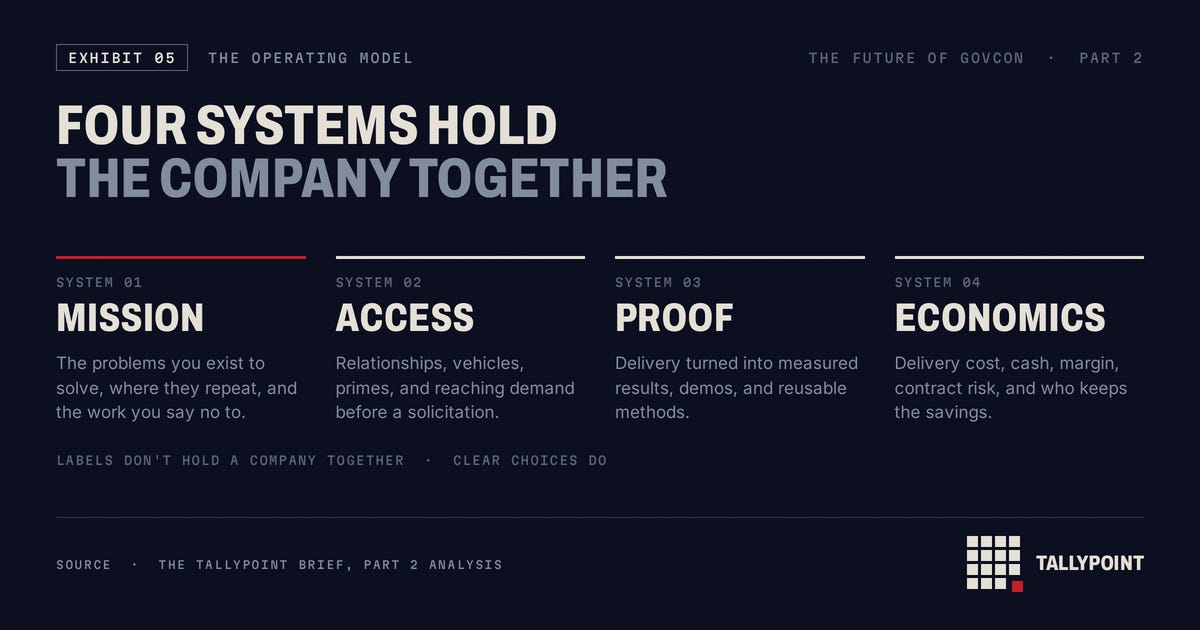
These systems matter more than whether the firm calls itself a services company, technology company, product company, or integrator.
Labels and certifications do not hold a company together. Clear choices do.
Access is part of the business model
GovCon companies often discuss contract vehicles as qualifications. I think they are closer to hunting licenses that give you access.
The market plan has to answer two different questions:
Who buys our solutions?
How can/will this customer buy from us?
A requirement without a real way for the customer to buy is not pipeline. A vehicle your target customers do not use is not much of an asset.
For a long time, that was good capture discipline. I am fortunate that it was how it was taught to me. Now Washington is turning it into procurement policy.
Executive Order 14240 started with a large target. The federal government spends approximately $490 billion each year on contracts for common goods and services. The order directed agencies to propose moving more of that buying through GSA. It also directed OMB to designate the GSA Administrator as executive agent for all IT governmentwide acquisition contracts and told GSA to rationalize that portfolio by cutting duplication and redundancy.[7]
OMB gave us more detail. In fiscal year 2024, $78.2 billion went through GSA vehicles and another $16.3 billion was awarded by GSA on behalf of other agencies. That still represented less than 20% of common spend going through GSA. The purpose of the new policy is to push that share higher.[8]
The rule changes are beginning to match the policy. The FAR overhaul’s model Part 8 language requires agencies to use an existing contract or blanket purchase agreement that OMB has designated for required use, unless the head of the contracting activity grants an exception. When no required-use vehicle fits, agencies are told to consider another governmentwide contract, blanket purchase agreement, or shared service before creating something new.[9]
Not every requirement will move to GSA. OMB’s own guidance recognizes that complex or mission-specific work may not consolidate well. But the direction is pretty darn clear. More spending will move through fewer front doors.
That changes the economics of access. A firm can understand the mission, know the customer, and still be unable to compete because it does not hold the route the customer has been told to use. In that case, the options narrow pretty quickly: find a prime, form a team, acquire access, or wait.
The future firm will manage a portfolio of contract vehicles. That may include vehicles it is on, vehicles reached through partners, open-market competitions, set-asides, prototype and pilot authorities, commercial paths, and sole-source awards where the rules allow them.
The portfolio will not be static. GSA put the first phase of Alliant 3 into use in March 2026.[10] OASIS+ moved in the other direction by keeping all six solicitations continuously open, with on-ramps across the unrestricted track and five small-business tracks.[11]
Those are two kinds of access. A company needs to know which one matters to its customers.
Each path is an investment. Each needs someone to own it. And each should connect to named buyers with funded problems. The point is not to collect vehicle logos. The point is to make sure the company can reach its target market.
The proposal is becoming the receipt
AI will make acceptable proposal writing easier to produce. More companies will create clean outlines, compliant drafts, polished resumes, and professional graphics.
That does not make capture less important. It makes unsupported claims easier for everyone to create and sound good.
Proof, real past performance with numbers behind it, will matter more.
The firm will need measured results, working demos, customer references, security evidence, realistic cost assumptions, and technical components that already work.
The proposal will package credibility built before the RFP. It will not create that credibility during the final writing sprint.
That changes the relationship between capture and delivery.
Delivery teams need to record what worked, how long it took, where the method failed, what the customer actually valued, and which parts can be used again. Capture teams need to pass operating assumptions, promises, risks, and proof they need for the next win back into delivery.
Most GovCon firms say their people are their strength. That is often true. It can also hide a weak operating model.
When the method exists only in the heads of a few senior staff members, the company does not fully own it. The knowledge can walk out the door when those key people leave. With modern IT systems, that knowledge has to become institutionalized. This is good news for small firms because knowledge can be shared quickly. It just needs to become an internal discipline.
The next firm will turn good delivery into company assets: standard workflows, decision rules, useful data, software components, training systems, quality checks, and performance benchmarks.
It will separate what must change for a new customer from what the company should not have to relearn every time.
AI forces the economics into the open
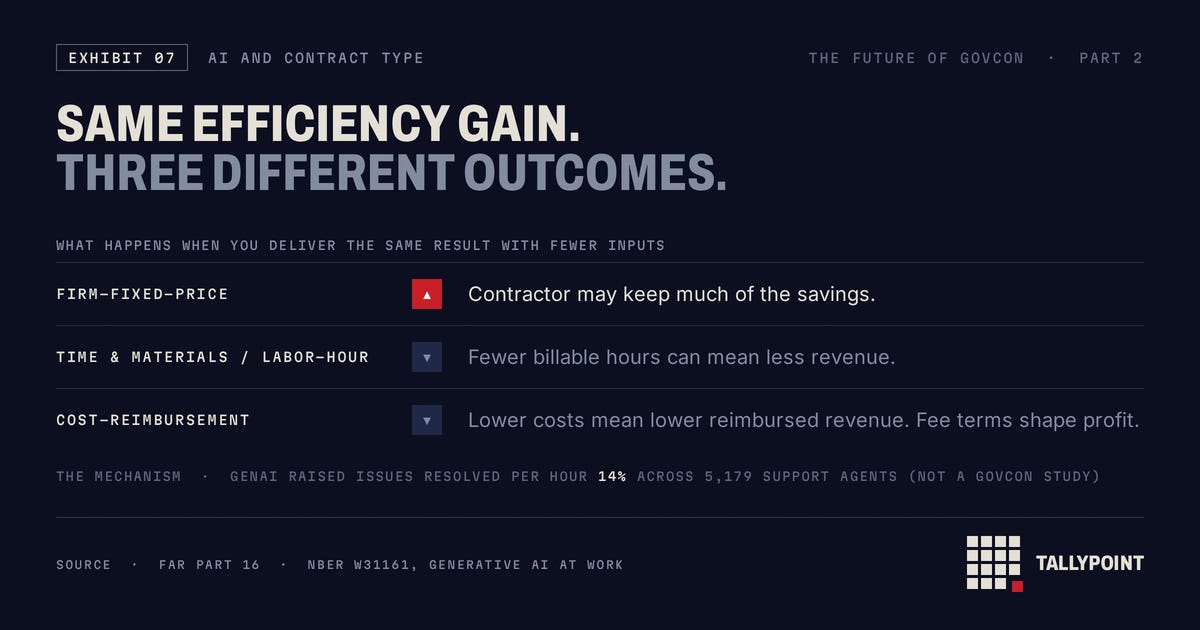
A study of 5,179 customer-support agents found that generative AI increased issues resolved per hour by 14% on average. Newer and lower-skilled workers gained the most.[10]
That was not a study on GovCon firms. Customer support is not proposal work, cleared engineering, or mission delivery. But the mechanism matters. AI can spread repeatable methods and shorten knowledge work.
GovCon firms will use it across research, proposals, reporting, finance, recruiting, contract administration, and delivery.
This is where contract type comes in.
On firm-fixed-price work, delivering the promised result with fewer inputs may let the contractor keep much of the savings. On time-and-materials or labor-hour work, fewer billable hours can mean less revenue. On cost-reimbursement work, lower costs generally mean lower reimbursed revenue, with the profit effect shaped by the fee and what the company does with the freed capacity.[14]
A firm can become more efficient without becoming more valuable.
The government already buys SaaS subscriptions and consumption-based cloud services.[11] Performance-based acquisition has also been the preferred method for buying services for years.[12]
But the future will not be a clean move from labor to software. Many federal problems still require judgment, relationships, secure facilities, field work, and human responsibility.
The better firm will use labor, fixed-price work, managed services, priced outputs, and commercial models where they fit. It will know what unit of value the customer buys, what that unit costs to produce, who keeps the savings, and which risks remain outside the company’s control.
A firm should not automate thirty percent of a labor-hour contract and act surprised when revenue falls.
Run a smaller, strategic pipeline
The federal government will keep spending heavily with small businesses. In fiscal year 2025, small businesses received nearly 28% of federal prime-contract dollars, worth about $179 billion.[13]
But the money will not be spread evenly.
More of it will flow through selected vehicles, commercial buying paths, better-capitalized firms, and contractors that can prove results instead of activity.
Small GovCon firms do not need to copy venture-backed technology companies. They do need to understand the new rules of competition.
Before funding the next pursuit, leadership should ask:
Mission: Does this work solve a problem we intend to keep solving?
Access: Can this customer buy from us through a credible route?
Proof: What evidence gives the customer a reason to choose us?
Economics: Can we deliver it profitability so we can build the business we want to build?
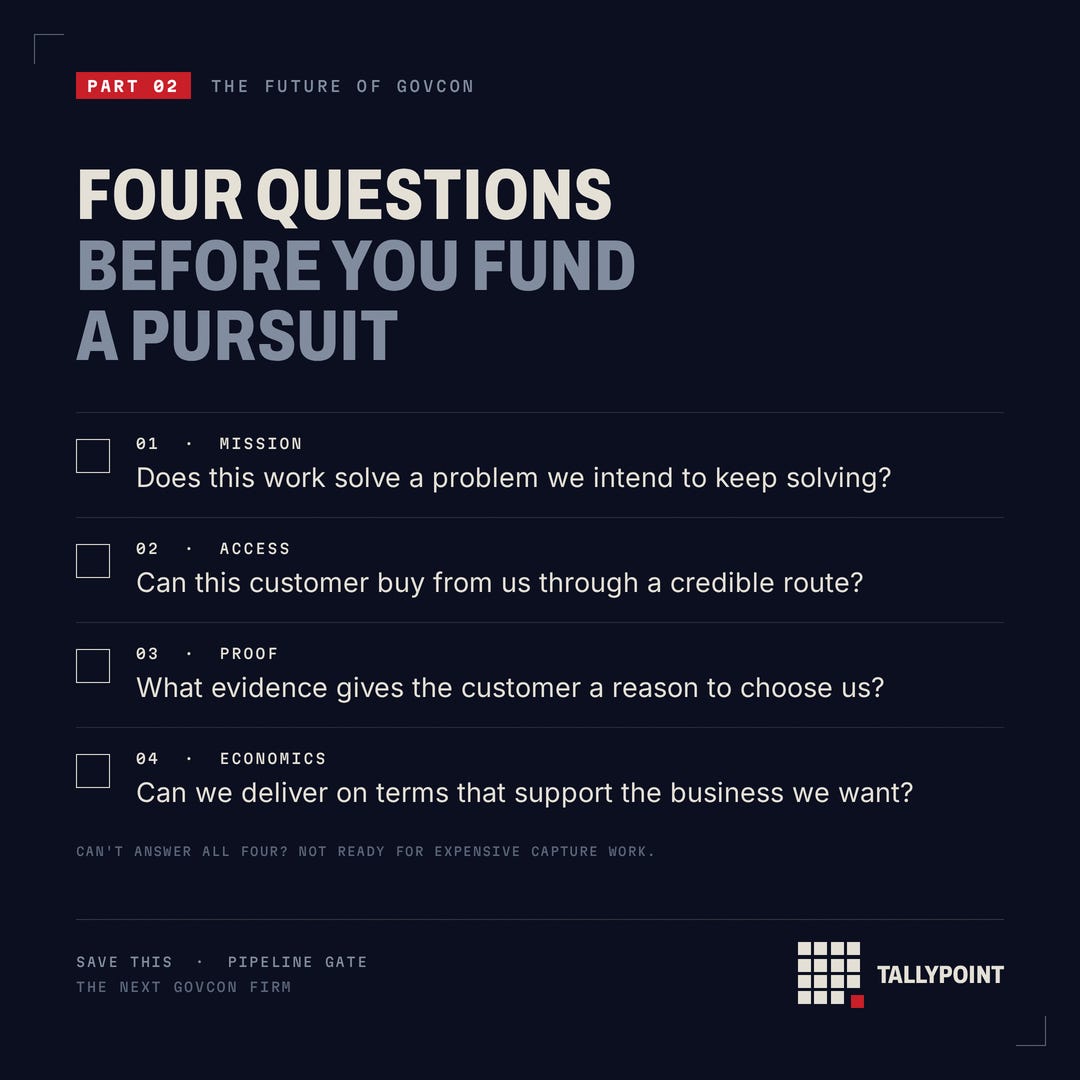
If those questions cannot be answered, the opportunity is not ready for expensive capture work.
The goal is not a pipeline with a longer list of opportunities. It is a list of opportunities the firm can win and deliver superior results on.
The old model rewarded access, compliance, and the ability to add people. Those things still matter. They are no longer enough.
The pursuits a company funds become the company it builds.
Leadership should choose them accordingly.
Sources
[1] https://www.defensenews.com/industry/2026/01/20/defense-tech-startups-had-their-best-funding-year-ever-in-2025 — Defense News: Defense Tech Startups Had Their Best Funding Year in 2025
[2] https://media.defense.gov/2025/Jan/02/2003623435/-1/-1/1/FY25-INVESTMENT-STRATEGY-FOR-OFFICE-OF-STRATEGIC-CAPITAL.PDF — DoD Office of Strategic Capital FY2025 Investment Strategy
[3] https://www.defense.gov/News/Releases/Release/Article/3963289/deputy-secretary-of-defense-kathleen-hicks-announces-additional-replicator-all — DoD: Additional Replicator Capabilities and Awards
[4] https://www.propublica.org/article/trump-peter-thiel-ramp-gsa-smartpay-expense-payment-system — ProPublica: Ramp and GSA SmartPay
[5] https://www.gsa.gov/about-gsa/newsroom/news-releases/statement-regarding-recent-reporting-about-the-gsa-smartpayr-program-02212025 — GSA Statement on SmartPay Reporting
[6]https://sam.gov/workspace/contract/opp/1f61e4d3b73f4bc8841b352aed3bd63e/view — SAM.gov: Canceled GSA Charge Card Pilot RFI
[7] https://www.whitehouse.gov/presidential-actions/2025/03/eliminating-waste-and-saving-taxpayer-dollars-by-consolidating-procurement/ — Executive Order 14240: Consolidating Procurement
[8] https://www.whitehouse.gov/wp-content/uploads/2025/07/M-25-31-Consolidating-Federal-Procurement-Activities.pdf — OMB M-25-31: Consolidating Federal Procurement Activities
[9] https://www.acquisition.gov/far-overhaul/far-part-deviation-guide/far-overhaul-part-8 — FAR Overhaul Model Part 8: Use of Existing Contracts
[10] https://www.gsa.gov/technology/it-contract-vehicles-and-purchasing-programs/gwacs/alliant-3 — GSA: Alliant 3
[11] https://www.gsa.gov/buy-through-us/products-and-services/professional-services/buy-services/oasis-plus/sellers-guide/solicitations-continuously-open — GSA OASIS+ Continuously Open Solicitations
[12] https://www.nber.org/papers/w31161 — NBER: Generative AI at Work
[13] https://www.gsa.gov/technology/it-contract-vehicles-and-purchasing-programs/multiple-award-schedule-it/cloud-and-cloud-related-services/cloud-sin-ordering-guidance — GSA Cloud SIN Ordering Guidance
[14] https://www.acquisition.gov/far/37.102 — FAR 37.102: Performance-Based Acquisition Policy
[15] https://www.sba.gov/article/2026/06/25/sba-releases-fy25-scorecard-small-business-contracting — SBA FY2025 Small Business Procurement Scorecard
[16] https://www.acquisition.gov/far/part-16 — FAR Part 16: Types of Contracts